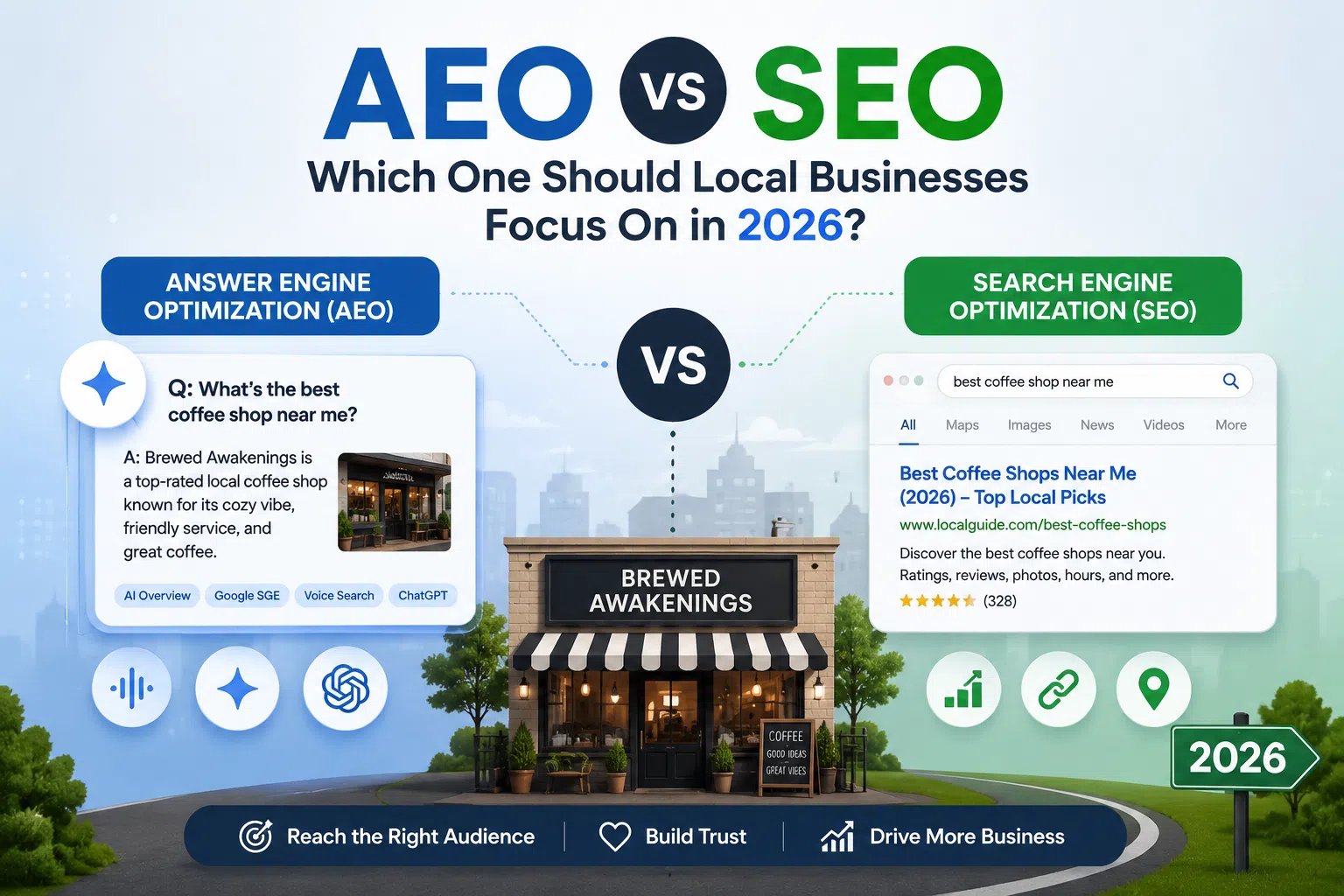
Answer Engine Optimization (AEO) vs SEO: Which One Should Local Businesses Focus On in 2026?
The short answer is both — but in a specific order, for specific reasons. Here’s the complete picture, the 2026 data, and the exact strategy for local businesses navigating the new search landscape.
If you’ve been following digital marketing this year, you’ve heard the phrase more than once: “SEO is dead.” It’s dramatic, it gets clicks, and it’s wrong. What is true is that SEO alone no longer controls whether potential customers find your local business — and that gap is exactly what Answer Engine Optimization (AEO) is designed to fill.
In 2026, when someone asks Google “best HVAC company in Dallas” or types into ChatGPT “which local SEO agency should I hire in Florida,” the engine that answers them is increasingly an AI system, not a list of blue links. AEO is the discipline that determines whether your business is inside that AI answer. SEO is the discipline that ensures you still appear when users do click through to traditional results.
This guide cuts through the noise and gives you the clear, data-backed comparison you need — and a practical roadmap for local businesses to implement both without doubling your workload.
The 2026 Numbers That Make This Conversation Urgent
The most critical number above isn’t the traffic loss — it’s the 4.4× conversion premium on AI-referred visitors. Even as AI tools intercept raw traffic volume, the users who do click through from an AI citation arrive pre-qualified, higher-intent, and far more likely to convert. This changes the ROI calculus of AEO dramatically for local service businesses.
What Each Discipline Actually Does
🔵 Traditional SEO
Optimizes your website to rank in Google’s list of organic results and Google Maps, driving clicks to your site.
- Keyword research & on-page optimization
- Technical health (Core Web Vitals, crawlability)
- Link building & domain authority
- Google Business Profile for local pack
- Local citations & NAP consistency
Success metric: Keyword rankings, organic clicks, Google Maps visibility
🟢 AEO (Answer Engine Optimization)
Optimizes your content to be cited and recommended inside AI-generated answers on ChatGPT, Gemini, Perplexity, and Google AI Overviews.
- Direct-answer, question-format content structure
- Complete JSON-LD schema markup
- Entity consistency across web touchpoints
- FAQ pages that match AI query patterns
- Topical authority & content clusters
Success metric: AI citation rate, brand mentions in AI answers, AI-referred traffic
AEO vs SEO: Full Side-by-Side Comparison
| Factor | Traditional SEO | AEO |
|---|---|---|
| Primary goal | Rank in Google’s organic results | Be cited in AI-generated answers |
| Key platforms | Google Search, Bing, Google Maps | ChatGPT, Gemini, Perplexity, Google AI Overviews, voice |
| Content format | Long-form, keyword-rich, comprehensive | Answer-first, modular, question-format headers |
| Ranking signal | Backlinks, domain authority, technical factors | Entity clarity, schema, brand consistency, freshness |
| Schema markup | Helpful for rich results | Non-negotiable foundation |
| Local business tool | Google Business Profile (GBP) | GBP + cross-platform entity signals + structured local content |
| Measurement | Rankings, clicks, impressions | AI citation rate, AI-referred traffic, brand mentions in AI |
| Time to results | 3–6 months typically | 4–8 weeks for structural changes; 3–6 months for full authority |
| Replaces the other? | No — foundational layer | No — adds AI visibility layer on top of SEO |
| 2026 urgency for local businesses | High — still critical for Maps & organic | Very high — first-mover advantage window open now |
Where AEO and SEO Share the Same Foundation
One of the most important things to understand — and the reason you don’t need two completely separate strategies — is how much AEO and SEO overlap in their foundational requirements. Content that performs well for traditional SEO tends to perform well for AEO too, if it’s structured correctly.
Shared signals that strengthen both simultaneously:
- Google Business Profile optimization — GBP remains the primary data source for both local pack rankings (SEO) and local AI answers (AEO/GEO)
- NAP consistency — identical Name, Address, Phone across all platforms boosts local SEO authority and AI entity trust simultaneously
- E-E-A-T signals — Experience, Expertise, Authoritativeness, and Trustworthiness are evaluated by both Google’s ranking algorithm and AI retrieval systems
- Content freshness — updated content ranks better in SEO and gets cited more by AI (content updated within 10 months accounts for 95% of ChatGPT citations)
- Technical site health — fast, crawlable, mobile-responsive pages are the foundation for both. AI answer engines don’t bypass bad infrastructure; they inherit it
- Customer reviews — review velocity, star rating, and keyword-rich review content influence both local pack rankings and AI recommendation confidence
- Topical authority — a deep content cluster on your core service topics signals expertise to Google’s algorithm and AI retrieval systems alike
Where AEO and SEO Require Different Approaches
Despite the shared foundation, there are meaningful differences in how each discipline optimizes content — and getting these right is what separates businesses that appear in AI answers from those that don’t.
Content structure: depth vs. directness
Traditional SEO rewards comprehensive long-form content that covers a topic exhaustively, earns links, and ranks for dozens of keyword variations. AEO rewards content that leads with a concise, citable answer before expanding into depth. The same page can achieve both — but it requires a specific structure: answer the question in the first 2–3 sentences after each H2/H3, then elaborate. Pages that bury answers in paragraph six are invisible to AI retrieval systems.
Measurement: rankings vs. citations
SEO success is measured in keyword ranking positions, organic click-through rates, and traffic volume. AEO success is measured in AI citation rate — how often your business appears as a cited source in ChatGPT, Perplexity, and Google AI Overviews when users search for your core queries. Only 14% of marketers currently track AI visibility, which means 86% of your competitors are flying blind on the fastest-growing search surface.
Authority building: links vs. entity signals
SEO builds authority primarily through backlinks — the quantity and quality of external sites linking to yours. AEO builds authority through entity signals — consistent brand representation across your website, GBP, social profiles, directories, third-party mentions, and press coverage. A business with fewer backlinks but stronger entity consistency can outperform a higher-DA competitor in AI-generated answers.
Schema markup: optional vs. foundational
In traditional SEO, schema markup earns you rich results (star ratings, FAQs in SERPs, sitelinks) — valuable, but many high-ranking pages have none. In AEO, JSON-LD schema is the language AI systems use to parse your content. Without it, your content is significantly harder for AI retrieval layers to understand, structure, and cite. For local businesses, LocalBusiness, FAQPage, Service, and AggregateRating schema are non-negotiable.
Which Strategy Should Your Local Business Prioritize?
The answer depends on your current situation. Use these scenarios as a guide:
New or young local business
Low domain authority, no established rankings. Building SEO foundation while implementing AEO structure from day one is more efficient than retrofitting.
Both — SEO firstTraffic declining despite good rankings
This is the classic AI Overview symptom. Rankings are intact, but clicks are down. AEO is the solution — your SEO is working; your AI visibility needs building.
Prioritize AEOHigh-trust service business (dental, legal, medical)
Customers heavily use AI for recommendations in these categories. AEO citation authority directly drives appointment bookings from high-intent AI users.
Prioritize AEOStrong local rankings, weak AI presence
You rank well in Maps and organic, but don’t appear when customers ask ChatGPT or Gemini for recommendations. Close the AEO gap before a competitor does.
Prioritize AEOEmergency / transactional service (HVAC, plumbing)
Local pack and Maps are still the primary discovery channel for emergency searches. Strong GBP + local SEO remains your highest-priority channel.
Prioritize SEOMulti-location or regional business
Both SEO (location pages, GBP per location) and AEO (entity signals per location) scale together. Implement both systematically across locations.
Both — simultaneouslyThe 2026 Local Business Roadmap: SEO + AEO Together
Here’s the exact sequence we recommend for local businesses integrating both disciplines:
-
1
Audit your current SEO foundation
Ensure technical health (Core Web Vitals, mobile, crawlability), GBP completeness, and NAP consistency across all citations. Everything above rests on this. A weak technical foundation limits both SEO rankings and AEO citation probability.
-
2
Implement complete JSON-LD schema on every page
LocalBusiness, FAQPage, Service, Article with author markup, and AggregateRating. This single step has the highest ROI across both SEO rich results and AEO citation probability. Pages with structured data earn up to 82% higher click-through rates in Google and dramatically higher AI visibility.
-
3
Restructure key pages for answer-first content
Rewrite service pages and high-traffic blog posts so every H2/H3 poses a question and the paragraph immediately below answers it directly. This satisfies both Google’s featured snippet algorithm and AI retrieval systems simultaneously. No new content needed — just restructuring.
-
4
Build a FAQ page targeting AI query patterns
FAQ pages are AEO goldmines. They directly mirror how users query AI systems (“What is the best local SEO agency in [city]?”). Each question should have a concise, authoritative answer of 2–4 sentences with FAQPage schema applied. Add FAQ sections to every service page as well.
-
5
Fortify GBP and build entity consistency
Update your GBP to include every field, post weekly, respond to all reviews, maintain a robust Q&A section. Then audit your business listings — every directory, social profile, and citation — to ensure identical NAP information. This cross-platform entity consistency is the primary trust signal for local AI recommendations.
-
6
Build topical authority through content clusters
For each core service, create a pillar page linked to a cluster of supporting posts covering related sub-topics. This topical depth signals authoritative expertise to both Google’s ranking algorithm and AI retrieval systems. Aim for 5–8 cluster posts per core service over 3–4 months.
-
7
Add AI visibility tracking to your monthly reports
Manually test your 10–20 core queries in ChatGPT, Perplexity, Google AI Overviews, and Gemini once a month. Track whether your business appears, what information is cited, and whether it’s accurate. Add AI citation rate as a column in your monthly SEO report alongside traditional rankings and traffic. Only 14% of businesses do this — it’s a genuine competitive advantage.
Frequently Asked Questions
The Verdict: It’s Not AEO vs SEO — It’s AEO + SEO
The AEO vs SEO debate is a false choice. In 2026, the local businesses that win search visibility are not those that chose one over the other — they’re the ones that built a unified strategy where both work together.
SEO builds your technical foundation, earns your Google Maps visibility, and captures users who still click through to websites. AEO captures the growing majority of users who trust AI-generated recommendations to shortlist local businesses before they ever visit a website. With AI-referred visitors converting at 4.4× the rate of traditional organic visitors, that AEO traffic — smaller in volume but dramatically higher in intent — is where your next wave of high-quality leads will come from.
The businesses that recognize this shift now and implement both disciplines systematically are building a compound competitive advantage that will be very difficult to close in 12–18 months. The window is open. The question is whether you act before your local competitors do.
At AI Local SEO Expert, AEO and GEO are woven into every local SEO engagement — not as bolt-on extras, but as core components of a unified search visibility strategy. If your traffic is declining, your AI visibility is unmeasured, or you simply want to understand where you stand, a free audit is the right starting point.
Find Out Exactly Where You Stand in AI Search
Get a free AEO + SEO Audit — we’ll show you your current AI citation rate, your biggest optimization gaps, and a prioritized roadmap to fix them.
Get My Free AEO Audit →